Why Car-Sharing Pioneers Failed and RV and Boat Platforms Survived
ReachNow, SHARE NOW, Maven, Gig and Getaround's US business all shut down. What they said went wrong, and why RV, boat and owner-to-owner platforms held up.

Ten years ago, car-sharing looked like the future of getting around a city. Carmakers launched their own services, cars you could unlock with an app appeared on street corners, and owning a car in a big city started to look optional.
Then, one by one, the big names left the US. This piece looks at what the companies themselves said when they shut down, what the services had in common, and why rental marketplaces where owners keep their own vehicles, RVs and boats have held up better.
The Shutdowns, One by One
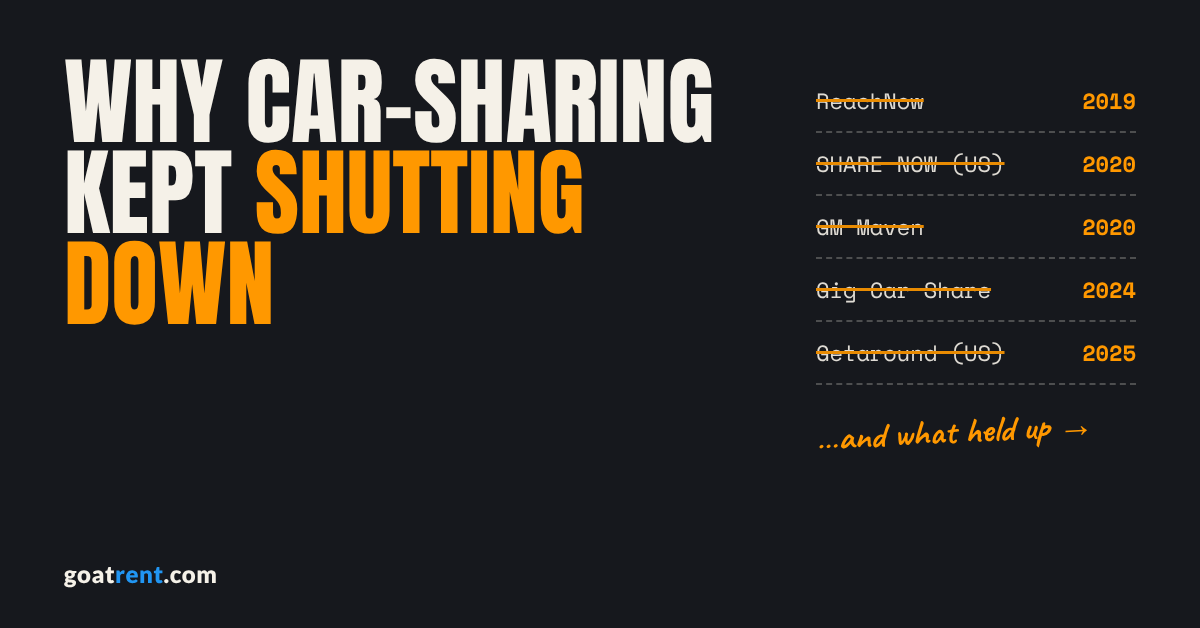
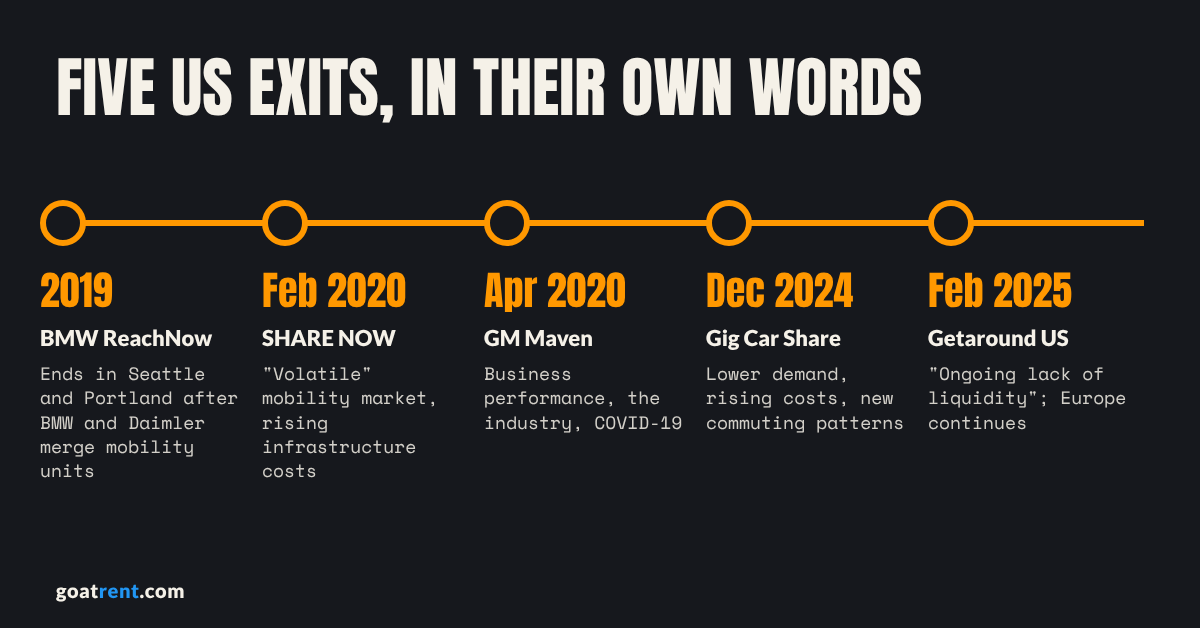
BMW ReachNow, 2019. BMW's service in Seattle and Portland ended in 2019, after BMW and Daimler merged their mobility businesses into a joint venture. TechCrunch described the end as abrupt.
SHARE NOW (car2go), February 2020. The joint venture's car-sharing brand left North America on February 29, 2020, ending service in Montreal, New York, Seattle, Washington, D.C. and Vancouver. It blamed "the volatile state of the global mobility landscape" and "the rising infrastructure complexities facing North American transportation today and the associated costs needed to sustain operations here." It said it was not in a position "to commit to the level of investment necessary" to make North America work.
GM Maven, April 2020. GM shut Maven down "effective immediately," citing business performance, the state of the industry and COVID-19. It had already closed Maven in eight cities in 2019, just under half of its markets.
Gig Car Share, December 2024. AAA's one-way car-sharing service in the Bay Area and Seattle closed at the end of 2024. AAA pointed to decreased demand, rising operational costs and changes in how people commute.
Getaround's US business, February 2025. Getaround, a peer-to-peer marketplace where hosts share their own cars, announced an orderly wind-down of its US operations on February 11, 2025, including HyreCar. Its interim CEO said that despite improvements in profitability and restructuring, the company "has faced an ongoing lack of liquidity which has made U.S. operations no longer viable." Its European business kept running.
What the Fleet Services Had in Common
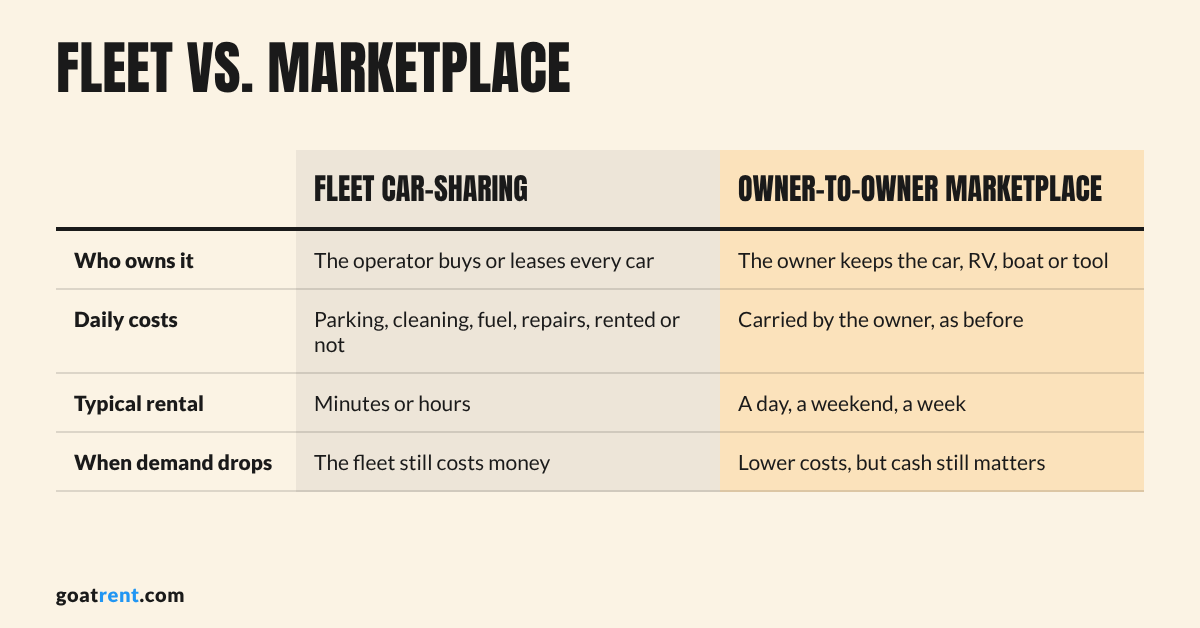
ReachNow, SHARE NOW and Gig ran their own fleets, and Maven started that way before it added peer-to-peer sharing in 2018. When the operator owns the cars, it pays for every one of them every day, rented or not:
- The cars themselves. Buying or leasing them, and losing value as they age.
- Parking and city fees. Free-floating cars need somewhere to sit between trips, and cities charge for it.
- Cleaning, fuel or charging, and repairs. Someone has to find each car and look after it.
- Short trips. Much of the use was by the minute or the hour, so each rental brought in little money against those fixed costs.
The reasons the companies gave fit that picture: rising costs, the level of investment needed, demand below expectations. Car2go raised its prices in 2019, Maven cut cities the same year, and SHARE NOW said it would not put in more money. A business that carries the whole fleet on its own books has very little room when demand dips, and in 2020 the pandemic hit.
Peer-to-Peer Isn't a Shield on Its Own
It's tempting to say "they owned the cars, so they failed." Getaround shows it's not that simple. Its hosts shared their own cars, and its US business still closed: in its own words, because of "an ongoing lack of liquidity," despite better profitability and restructuring.
So owning nothing lowers the risk, but it doesn't remove it. A marketplace still has to keep its own costs in line with what it earns from each rental.
What Held Up: Bigger Things, Rented for Longer
The platforms still growing look different:
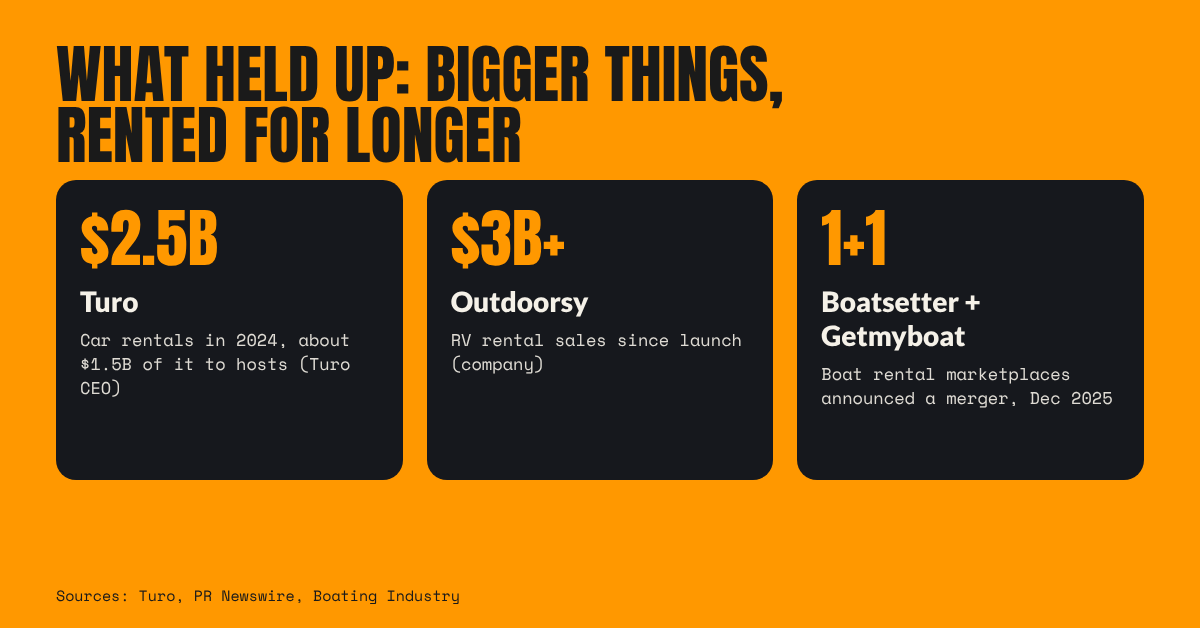
- Turo, where owners rent out their own cars, says it moved about $2.5 billion in car rentals in 2024, with hosts earning about $1.5 billion of it.
- Outdoorsy, an RV rental marketplace, says it has passed $3 billion in sales since launch.
- Boatsetter and Getmyboat, two boat rental marketplaces, announced a merger in December 2025 to form one larger marketplace, with both apps staying active.
What they share: the owner keeps the asset and its costs, the platform connects people and handles the booking, and rentals are usually measured in days, not minutes. An RV or a boat rented for a weekend brings in far more per handover than a car rented for twenty minutes, so the work of each rental pays for itself.
What This Means for Renting Gear
Trailers, tools, machinery and boats sit closer to RVs than to city cars. They are expensive to own, used a few times a year, and rented by the day or the week. An owner who already has a dump trailer or a mini excavator doesn't need anyone to buy a fleet; they need a way for people nearby to find it, book it and hand it back in good shape.
That's the model GoatRent is built on. We own no inventory. Owners list for free, set their own prices and dates, and keep their gear. Renters search the map, send one request, and every rental gets a PDF agreement and photos at check-in and return. Rentals are paid by card through Stripe, and GoatRent keeps a 10% fee from the owner's price, so the platform's own costs stay light. For the full picture, see how peer-to-peer rental works.
FAQs
Why did so many car-sharing services shut down?
The companies cited rising operating and infrastructure costs, the investment needed to keep going, demand below expectations and, in 2020, COVID-19. Most of them owned the cars, so they carried those costs whether the cars were rented or not.
Is car-sharing dead in the US?
No. Several fleet services left, but owner-to-owner car rental keeps growing: Turo says it moved about $2.5 billion in rentals in 2024.
Did peer-to-peer car-sharing fail too?
Getaround, a peer-to-peer platform, wound down its US business in 2025 because of a lack of cash, while its European business continued. Peer-to-peer lowers the cost of owning a fleet, but a marketplace still needs its own costs to fit what each rental earns.
Final Words
Got a trailer, a boat or a machine that sits idle most of the year? That's exactly the kind of asset that works on a marketplace: you keep it, and it earns when someone nearby needs it. List your gear
Sources
- TechCrunch, Share Now is exiting North America and three European cities, December 18, 2019
- TechCrunch, Car2go hikes hourly rental rates, August 9, 2019 (ReachNow's end)
- GeekWire, BMW's ReachNow shuts car-sharing service in Seattle and Portland, 2019
- Engadget, GM's Maven car-sharing service is shutting down, April 21, 2020
- GeekWire, Gig Car Share shutting down in Seattle, 2024
- Getaround, press release on the wind-down of US operations, filed with the SEC, February 11, 2025
- Turo, Celebrating 13 years of Drive (2024 bookings and host earnings), March 2025
- PR Newswire, The Outdoorsy Group exceeds $3 billion in sales
- Boating Industry, Boatsetter and Getmyboat announce merger, December 22, 2025