Rent More, Make Less: The Environmental Case for Renting Instead of Buying
The greenest pressure washer is the one that never had to be built. No mine dug for its steel and copper, no factory running to mold its plastic, no container ship, no cardboard box, and no trip to the landfill ten years later.
That sounds obvious, but it changes how you think about "eco-friendly" gear. Most of a product's footprint is locked in before it reaches your garage. Whether you use it once or every weekend, that footprint has already happened. Renting is one of the few ways to spread it across many more uses.
Forget the money for a minute. This piece is about the materials, emissions and waste that a little sharing can avoid.
The Footprint Starts Before You Open the Box
When we think about emissions, we picture tailpipes and power plants. But a huge share of the world's greenhouse gases comes from turning raw materials into the things we buy.
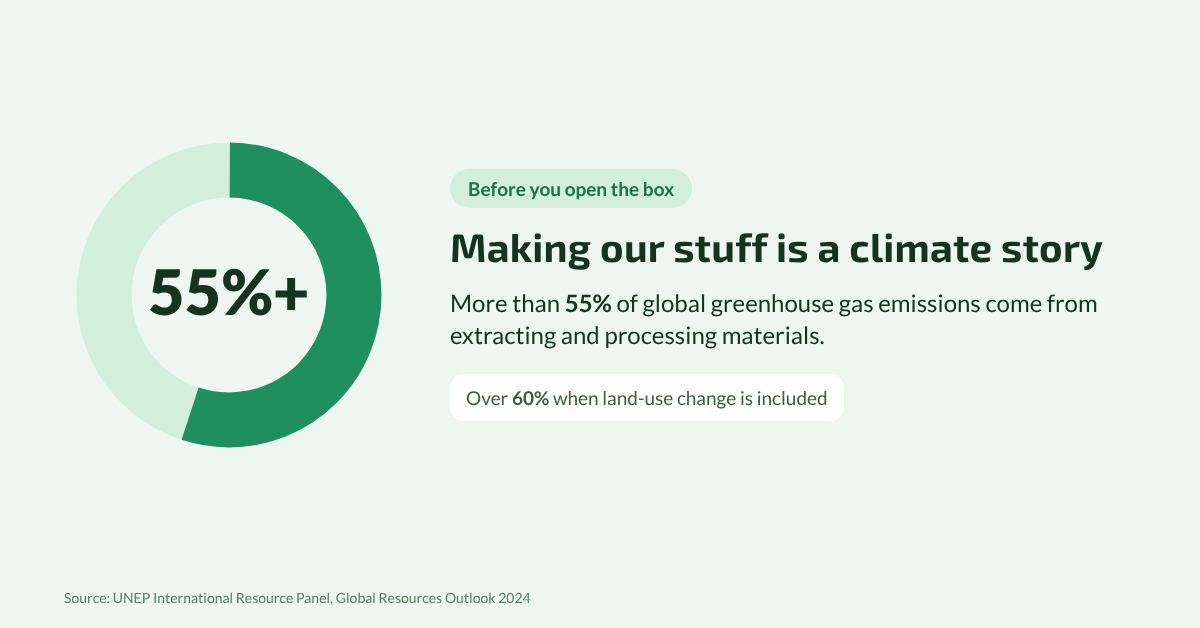
The UN's International Resource Panel put a number on it in its Global Resources Outlook 2024: extracting and processing material resources causes more than 55% of global greenhouse gas emissions, and over 60% once land-use change is counted. Global resource extraction has roughly tripled in 50 years.
Researchers who trace emissions back to the people who end up buying things reach a similar picture. A widely cited study in the Journal of Industrial Ecology (Ivanova and colleagues, using 2007 data) found that household consumption drives more than 60% of global greenhouse gas emissions once the full supply chain is counted.
None of this means a single drill is wrecking the climate. It means the most effective lever is often the simplest one: make fewer things, and use the ones we have more.
And Then There's Where It Ends Up
The other end of a product's life is just as heavy.
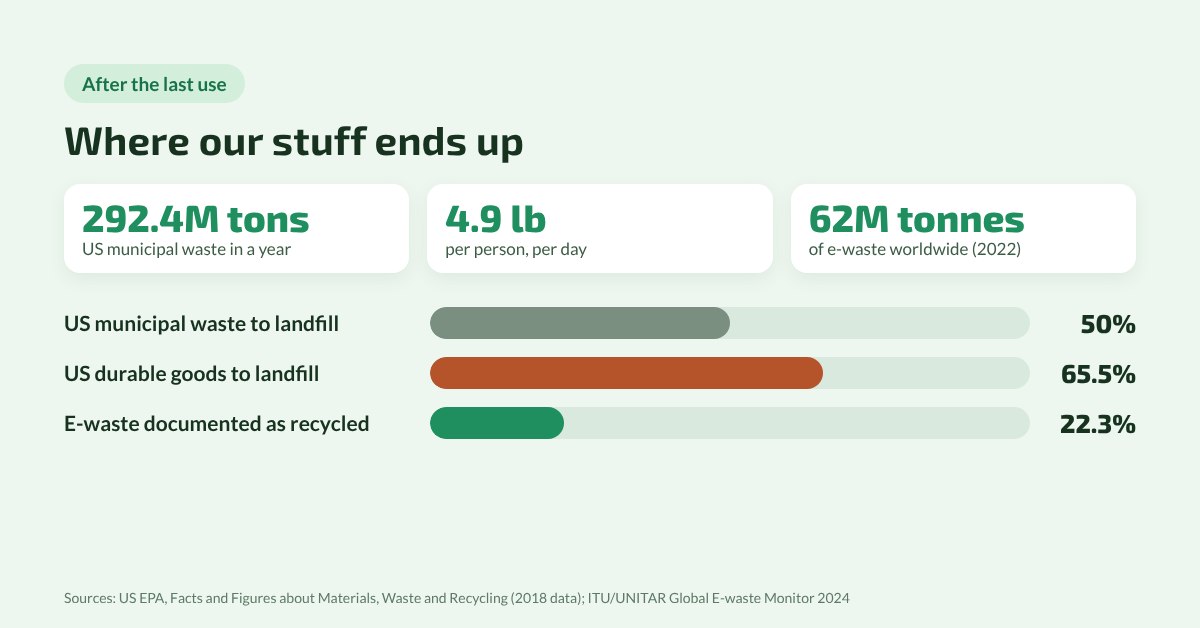
In the United States, the EPA's latest full count found 292.4 million tons of municipal solid waste in a year, about 4.9 pounds per person per day. Half of it went to landfill.
Durable goods, the category that covers appliances, furniture, tools and other things meant to last, came to more than 57 million tons. They also have the highest landfill rate of any product category: 65.5%, or about 37 million tons a year.
Electronics are their own problem. The UN's Global E-waste Monitor 2024 counted 62 million tonnes of e-waste worldwide in 2022, up 82% since 2010. Only 22.3% of it was documented as properly collected and recycled. Every cordless tool, battery charger and e-bike eventually joins that pile.
About That "13-Minute Drill"
You may have heard that the average power drill is used for just 12 or 13 minutes in its entire life. It's a great line, and it gets repeated in books, talks and newspapers. Nobody has ever traced it back to an actual study. The earliest versions we could find are blog posts that gave no source at all.
So we won't lean on it. But you don't need the exact number to see the point. Walk through any garage and count the things used a few times a year: the tile saw from one bathroom, the carpet cleaner, the camping stove, the trailer, the pressure washer. A 2026 survey for an EU-funded neighbourhood sharing project found that most households owning a pressure washer or a hand sander considered it underused.
What Renting Changes
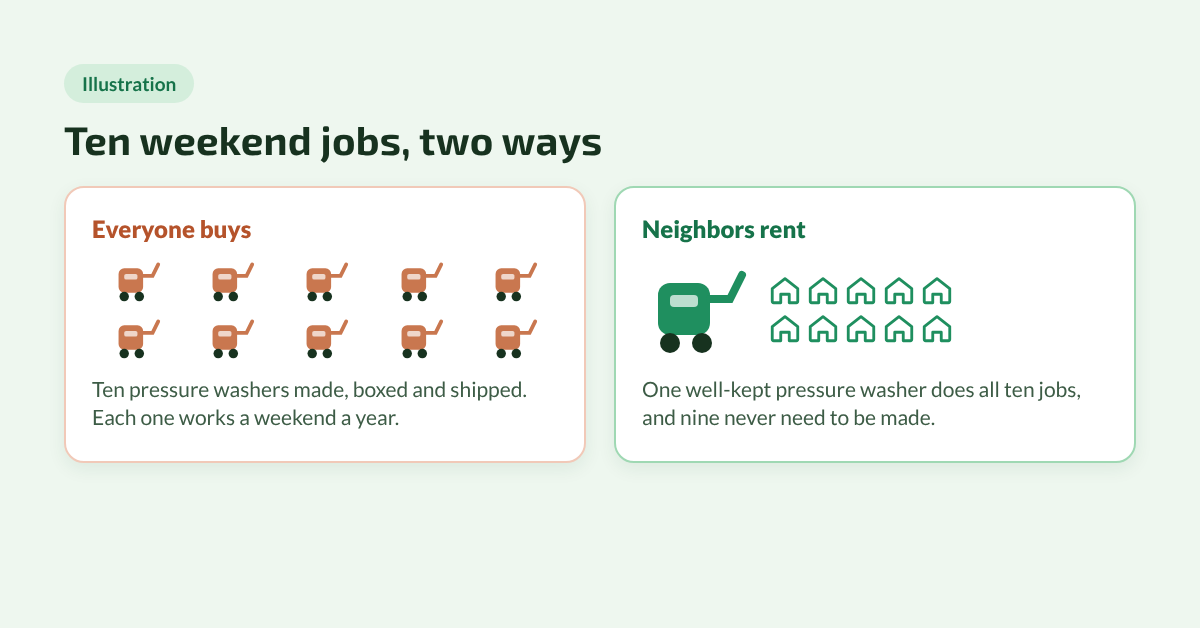
When ten households each need a pressure washer for one weekend a year, the usual result is ten pressure washers: ten sets of metal, plastic and motors, ten boxes, ten deliveries, and eventually ten items in the waste stream.
When those households rent from a neighbor instead, one well-kept machine can do the same ten jobs.
That is the core of the environmental case for renting:
- Fewer things made. Less mining, less factory energy, fewer emissions baked into products that mostly sit on shelves.
- Less packaging and shipping. No new box, no new delivery for every new owner.
- Less waste. One item used fully, instead of several used a little and thrown away at the same age.
- Better gear, kept longer. Owners who rent their equipment out have a reason to maintain it, and a well-maintained tool simply lasts longer.
Making Sure Renting Is Actually Greener
It would be easy to stop there, but the research is more careful, and so should we be.
A 2024 review in Environmental Research Letters went through 155 studies of the sharing economy. Its conclusion: sharing is not automatically greener. Sharing physical goods generally does better than shared rides or short-term stays, but the result depends on how people get the item and what they do with the money they save.
Transport matters most. A Swedish study of rental from a tool depot found that the car trips to pick up and return equipment could outweigh the savings from making fewer products. Local, peer-to-peer rental helps exactly here, because the item is usually a few minutes away rather than across town.
So here's how to make your rental count:
- Rent close to home. Search near you first. A short drive, a bike ride or a walk keeps the trip from eating the benefit.
- Combine trips. Pick up on the way to somewhere you're already going, and return the same way.
- Book the days you need in one go. One longer rental beats several short ones with a trip each.
- Skip buying the backup. If you can rent the specialty tool, you don't need to own the "just in case" version too.
- Treat it well. Clean it, return it on time, report problems. A tool that lasts longer is the whole point.
For Owners: Your Idle Gear Is Already Paid For, Twice
If you own something that sits most of the year, it has already cost money and materials. Renting it out doesn't add to that footprint. It means the next person who needs it may not have to buy their own.
Owners can make the biggest difference by keeping gear in good shape, listing the things that are used least, and offering pickup times that make short trips easy.

Final Thoughts
The cleanest product is the one that doesn't need to be made. Renting won't fix the climate alone, but it's one of the easiest ways to make the things that already exist do more work. List your gear on GoatRent and let one tool do the job of ten. List your gear

Sources
- UNEP International Resource Panel, Global Resources Outlook 2024
- Ivanova et al., study of the environmental impact of household consumption, Journal of Industrial Ecology, 2016
- US EPA, Facts and Figures about Materials, Waste and Recycling (2018 data) and Durable goods data
- ITU and UNITAR, Global E-waste Monitor 2024
- Meshulam et al., review of 155 empirical studies of the sharing economy's environmental impact, Environmental Research Letters, 2024
- Martin, Heiska and Björklund, study of a tool-rental service from a depot, Journal of Cleaner Production, 2021
- Interreg North Sea, Understanding household product ownership, use, and opportunities to support neighbourhood sharing stations, 2026